This post was originally published on Feb. 21 2016 on my old website.
Ask anyone in my family and they’ll tell you that I’ve always been a reader. I always had to think for a while about what books I would be taking with me to family holiday parties and events, and for most of my life the various bedrooms I’ve occupied in our house have had as their dominant feature two (or sometimes three) bookshelves, which were always as loaded down with books as they could be.
Time and life have a way of stealing certain joys away from you, at least to a certain extent. Once I started working as a teenager I definitely felt that I had less time for books, and so I would only read in spurts: I’d devour a whole book over a weekend and hungrily start another, only to find my appetite wane within a few days, leaving far too many novels unread.
Coming to college was, ironically, and sadly, perhaps even worse for my life as a reader. With homework and other responsibilities, reading, even smaller articles or chapters for classes, often got pushed to the side. (I think this is sadly the case for most college students at varying points in their academic careers.) I’d read a book or so over breaks, and a few more over the summers, but that was about it until the summer before my senior year. In preparation for being a teaching assistant for last fall, I read five books to get myself ready for the class I would be helping out with, and accompanied those five academic books with a collection of novels by H.G. Wells.
Upon returning to school in the fall, I learned that I’d only read about half of the books that I really needed to for the classes that I was acting as a TA for, and so was suddenly spending more and more time reading every day after classes to catch up–and I loved it. It helped that the books were about interesting topics (society and robots, for the most part), but more than that I was simply enjoying reading again, more than I had in a long time. I was learning, and writing, and thinking, and it was wonderful.
This year, inspired in part by some friends here at Geneva, my wife and I resolved to read more, and so challenged ourselves by setting goals: Kathleen decided to read 26 books in the 52 weeks of 2016 (or one book every two weeks), and I decided to do my best to read a book a week, or 52 books in 52 weeks.
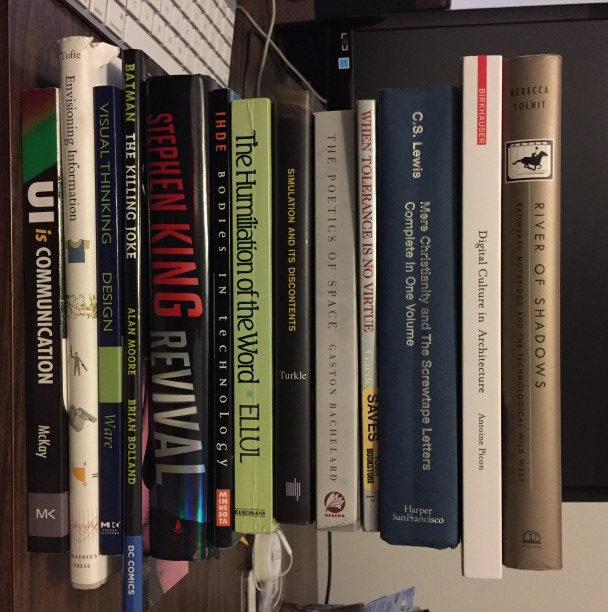
Thankfully, I’m a quick reader, and January was a fairly open month, and so I got a significant head start on my list. As of this writing, I’ve actually just finished by fifteenth book of the year (though the picture at the top of this post only features the first 13 I finished, which comprised the first 1/4 of my total goal for the year).
Given the rate at which I’m reading and completing books (spurred on mostly by research papers, at this point) I probably won’t draw excessive attention to or write about every book that I read, but I’ll probably mention them here at some point, and thought I’d start by providing a bit of a review of those that I’ve already finished. If anyone is interested in doing this type of challenge themselves, it’s certainly not too late in the year to start!
- Batman: The Killing Joke by Alan Moore and Brian Bolland – I started the year off relatively easily with a graphic novel, I’ll admit, but it’s also truthfully one of the classics of the medium. The art and color was stunning and Alan Moore’s script was tremendous as always (see V for Vendetta or Watchmen, for instance), making this a fun way to start the challenge.
- Revival by Stephen King – In a certain sense, this could probably be considered a disappointing King novel: it’s a clear Frankenstein pastiche, and its themes of faith and science in conflict are almost too simply and archetypically drawn. But in spite of its flaws, Revival works, mostly because its characters, but also because its got a sense of fun and delight in the midst of the macabre that you can’t help but enjoy.
- The Poetics of Space by Gaston Bachelard – The first of many more academically-based books, this is a fascinating study of depictions of homes and other spatial representations in art and poetry. While not explicitly labeled a phenomenological work, the type of exploration Bachelard engages in is clearly related to the field, and was a fascinating (albeit occasionally repetitive in terms of form) read. It’s probably not exactly everyone’s kind of book, but I enjoyed it quite a bit.
- Bodies in Technology by Don Ihde – These essays exploring the relationship between bodies and embodiment in virtual and mechanical spaces is an incredible read. The text is short and fairly simple to get through, though it does presuppose some familiarity with phenomenological vocabulary and concepts. The fun thing about the book is really just how it calls into question the assumptions that we make about our relationships to our technologies, and where we position ourselves and our bodies in relation to them.
- Visual Thinking for Design by Colin Ware – As someone generally averse to science-related things, this book about the relationship between the processes of visual perception and how those relate to things like graphic design was pretty fascinating. I sometimes got lost in or simply skipped over Ware’s extended explanations of eye and brain physiology, but the lessons for design that he establishes are incredibly useful for anyone in a design or visually-based field of work.
- Digital Culture in Architecture by Antoine Picon – Picon’s thesis is that the field of architecture is in some ways shifting as a response to the influence of digital spaces and digital means, changing to reflect the values, aesthetics, and principles of the online world. Digital culture is becoming physical culture, and part of what Picon seeks to explore is the question of whether or not this is a good thing. This book was a tough read in places, blending cultural commentary and observation with fairly specific diagnoses or examples, often using the language of fields of study with which I’m not familiar.
- Envisioning Information by Edward Tufte – Another book on graphic design, with a specific focus on critiquing various ways in which massive amounts of information can be displayed. The book is great for establishing and illustrating principles for how these sorts of designs ought to work, but I think it ignores some facets of practicality in some of the examples it uses. The book is gorgeous, though, custom designed and published by Tufte himself to ensure a rigorous adherence to exemplary standards of reproduction for the visuals contained inside and out.
- The Screwtape Letters by C.S. Lewis – I’d read selections from these letters throughout the years, but I’d never sat down and actually read through them all before. I loved them; they’re simple in their language, yet profound in their implications. I’m thankful to still be talking about them in class weekly, which provides a nice outlet for feedback and discussion on the insights that Lewis provides.
- Simulation and Its Discontents by Sherry Turkle – Turkle has spent most of her academic career studying human-computer interactions at MIT. For this case study, she follows the adoption of computers into the academic sphere, and later examines their use in the professional sphere by several architectural firms. The overall tone of the book is one of questioning, asking readers whether or not something is being lost by consistent reliance upon the complex, incomprehensible machines we find ourselves surrounded by. A thought-provoking, sometimes troubling read.
- When Tolerance is No Virtue by S.D. Gaede – I read this in a class on intercultural communication several years ago, and was struck then by the straightforward approach taken to the often muddy issue of multiculturalism in today’s culture. Prescribing a return to truth and genuine Christian values as the only solution to what is still a very much relevant societal problem, Gaede’s book is as refreshing as it is convicting.
- The Humiliation of the Word by Jacques Ellul – Maybe one day I’ll write about how influential Jacques Ellul’s work has been on my own thinking and work. In this book, Ellul turns his attention to the saturation of images in contemporary society, and the seeming abandonment of words and language. Saturated in a scriptural approach to examining the importance of the word and language in the relationship between God and men, this was a particularly interesting read given my own fascination with images, and my job as a videographer.
- UI is Communication by Everett McKay – The premise of this book is good: teach designers to approach their work as if they are involved in a communicative exchange with their users – which they certainly are. Unfortunately, I think McKay goes a little overboard with examples and explanations of what could have otherwise been a fairly concise volume. The fundamentals of his approach are good, but the book itself is bloated and pretty boring.
- River of Shadows: Eadweard Muybridge and the Technological Wild West by Rebecca Solnit – Ostensibly a biography of the man who made possible the capturing of high-speed events on film, such as the running stride of horses, this book is almost more of a cultural biography of California and the West around the turn of the nineteenth century. The portraits Solnit paints of a variety of well-known figures from the time, and the way she captures the pervading spirit of adventure and progress is admirable. I came away with a greater appreciation for the science of photography and the cultures it helped preserve and destroy, though I felt that any greater understanding of the photographer Eadweard Muybridge himself had actually been evaded.
- The Film Sense by Sergei Eisenstein – Considered the father of modern film editing and montage theory, I knew I would eventually have to read some of Eisenstein’s own work, and I’m glad I did. Through discussions of editing constructs and aesthetic theory, the relationship of music to images, and the meaning of color in film, Eisenstein provides a very thorough introduction to some of the difficult choices that a director must make in the creation of an effective, evocative film. This book is definitely not for everyone: Eisenstein sometimes gets fairly in-depth with his examples, to the point of tedium. As someone very interested in scholarship relating to film, however, this was quite an interesting peek into the mind of one of the founding fathers of the art of film.
- Gollum: How We Made Movie Magic by Andy Serkis – This production diary of sorts from the actor who helped bring Gollum to life in The Lord of the Rings films was something that I read primarily as research for a paper on phenomenology and CGI characters that I’m working on. Part memoir, part technical documentary, the book was a fairly basic overview of the great complexities involved in bringing a character “to life” onscreen through digital means, but was also helpful in its discussions of the sorts of embodiment and psychological depth that actors bring to the roles they inhabit.
This week, I’m hoping to have time to delve into a few more books relating to phenomenology and media, though work and some upcoming decisions regarding graduate school may push some of that work back. In any case, it’s great to be reading, and learning, and thinking about interesting stuff.
 Zachary Sheldon