Spoilers for Stranger Things ahead–maybe not necessary to say at this point, but you never know.
Right now it feels like everyone I know is Stranger Things-crazy (or at least they were about a month ago, immediately after the second season came online), and with pretty good reason–the show is overall pretty phenomenal, with great characters, an interesting storyline, and, you know, Steve Harrington.

It feels documented well enough elsewhere that the show is something of a hybrid construction, combining the wonder of Steven Spielberg’s early work with elements of horror and nostalgia lifted straight from Stephen King–these similarities and the show’s intentional homage to such elements seems well-known to the degree that I don’t even think it necessary to cite the plethora of other blogs and news articles that make these kinds of connections. And for the most part these are good–even great–things. As a total sucker for Spielberg and King in particular, as well as the many derivatives that have followed their groundbreaking paths (here’s looking at you, Super 8), Stranger Things definitely nails that combination of ingredients in such a way that the product at the end is an enjoyable work that feels familiar and yet is independently enjoyable as an original, inventive story.
Enjoying all of these elements coalesce into one new story was particularly enjoyable in the first season, and the second season largely succeeds in continuing down that path while also introducing enough new elements to keep it fresh. However, there is one element to this second season that seems a misstep to me, something that mostly feels out of place because of how it seems to follow in similar footsteps to some aspects of Spielberg and King, when in fact it radically departs from the conventions and even (seemingly) the moral underpinnings of those two artists.
The problem I’m specifically referring to is the problem of anger, and how the moral lesson that the show ultimately imparts–perhaps unknowingly or accidentally–is that being angry and using one’s anger is something that is alright to do and, in some cases, actually encouraged.
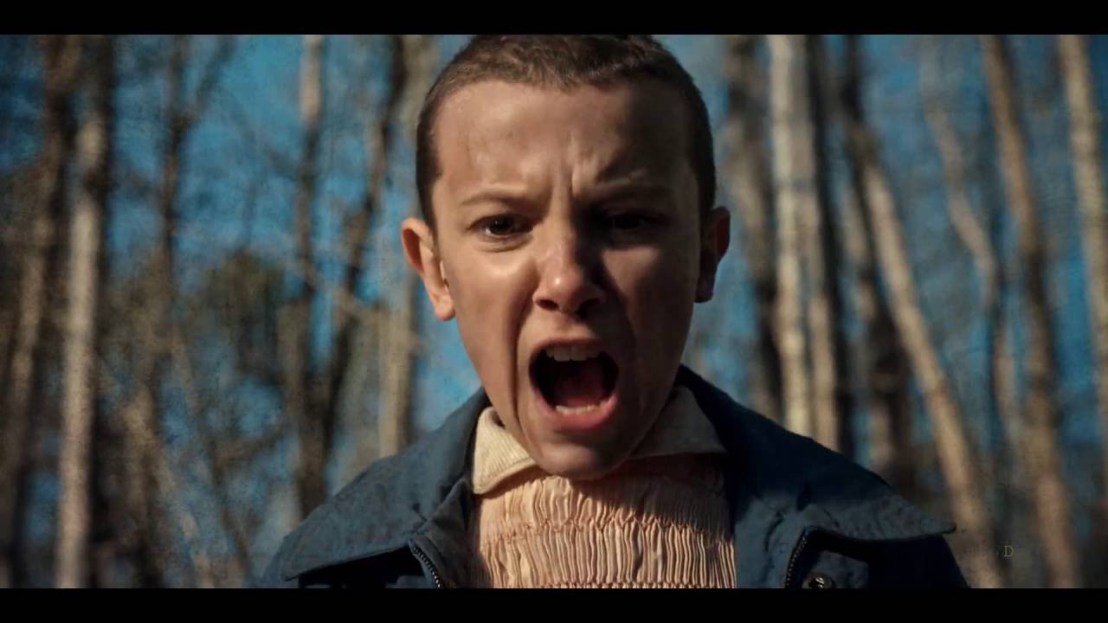
In the concluding episode of season one, the Demogorgon monster is bearing down on Mike, Dustin, Lucas, and Eleven. Using her telekinetic powers, Eleven pins the monster against a wall and walks sternly towards it, her brow deeply furrowed and anger clearly written on her expression. Mike, Eleven’s best friend and crush in the group, even tries to get her to stop what she is clearly about to do, and Eleven flings Mike back against a set of cabinets with a flick of her hand.
As the others look on in awe, Eleven approaches the monster steadily. Upon reaching the monster she turns back, says goodbye to Mike, then faces the monster. “No more,” she says, before raising her hand towards the creature as if to concentrate her power in its direction. The monster shrieks as Eleven begins to scream, her hand moving rapidly as the monster howls in pain as it begins to disintegrate, ultimately disappearing in a flash and seemingly taking Eleven with it.
So at the end of season one, Eleven’s anger is proffered as a solution to the town and group’s problems. Her anger is righteous and even sacrificial, and so understandably noble and sensible as an ending. But, it is worth noting, it is still anger.
Season two opens not in the good ‘ol Hawkins, Indiana that viewers have come to know and love, but rather in Pittsburgh, where a punk-infused gang of anarchists have perpetrated some kind of crime. Here we are introduced to Kali, who we quickly realize is also linked to the Hawkins Lab by virtue of the tattoo on her arm, which reads “008,” immediately calling to mind the tattoo of “011” that gave Eleven her name.
Kali makes a return in the episode “Chapter Seven: The Lost Sister,” where Eleven tracks her down and is introduced to the crew of outcasts that she heads and protects using her psychic powers. Recognizing Eleven as an asset that can be used in her mission of enacting revenge upon those who have hurt her and her friends, Kali looks to train Eleven in the more specific use and application of her powers. This involves trying to get her to pull a train car towards herself, which Eleven ultimately succeeds in doing through Kali’s constant encouragement to use Eleven’s anger, to channel it and focus it in a productive manner. To pull the train in, Eleven sees in her mind’s eye her beloved Mike interacting with the girl Max in the Hawkins Middle School gym–a scene which Eleven saw through the gym’s door, but in fact misinterpreted.
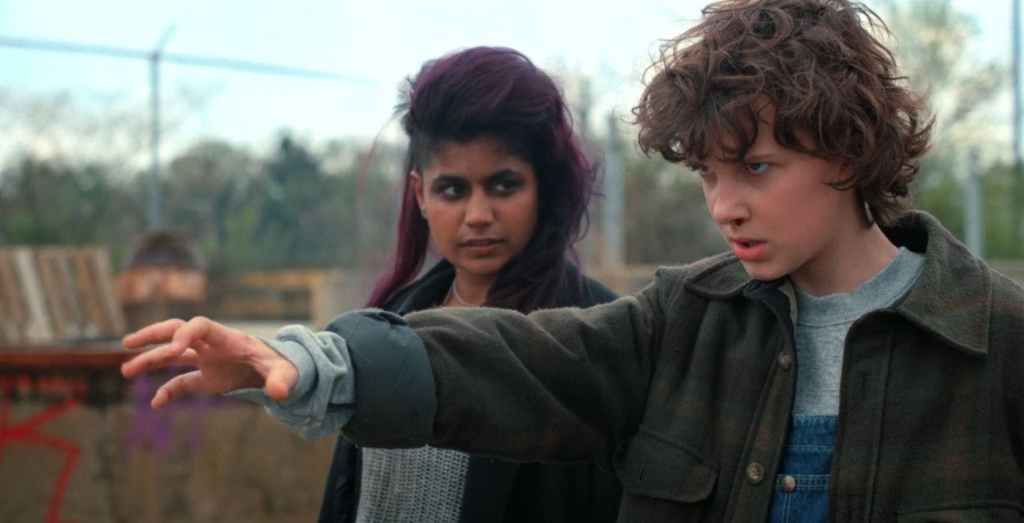
This episode ends with Eleven abandoning Kali and her crew to make a return to Indiana in order to help those that she loves, who she recognizes as being in danger. Neither Eleven nor the show necessarily pass judgment on Kali and her gang, ultimately, the vibe one gets is that Eleven is disenchanted with the mission of revenge and even murder that Kali and her gang have embarked upon. While still connected via their experience with Dr. Brenner and Hawkins Lab, Eleven and Kali may be seen as exemplars of good and evil respectively. Eleven uses her powers out of a sense of duty and love towards her friends, and a concern for their well-being. Kali cares for her friends, true, but her (and their) primary concern is selfish. While it is understandable to want to receive some kind of compensation for the pain and suffering she and her friends have experienced, Kali’s way of doing so emphasizes direct intervention and revenge, and is motivated by hate and not by justice.
Eleven does not hate Kali and her friends, but rather sees their mission as flawed, dangerous, and even hurtful. While not directly pronouncing judgments on their actions, it is clear that Eleven is uncomfortable with them, and wants no further part in them as she makes her decision and leaves for Indiana. We as viewers are intended to cheer for Eleven’s decision to remain loyal to her friends, and to view her in a singularly positive light for this.
Skipping ahead a little bit, the ultimate conclusion to the problems of season two are once again solved by Eleven’s anger. Here she channels her rage to close up the gate that has opened between Hawkins and the Upside Down, pulling on all the injustices done to her and her loved ones to provide her with the strength necessary to accomplish the task. Once the job has been done, the show fades to the season epilogue occurring one month later, where Eleven and the other kids happily attend the Snow Ball dance, in spite of ominous threats lurking in the Upside Down.
All in all, the season ends pretty satisfactorily, particularly in relation to the child characters and their relationships with one another. However, one frustrating thing is left unaddressed and unaccounted for: Eleven’s anger.
Two years in a row, now, Eleven has used her rage–a controllable rage, notably–to solve the town’s problems. Perhaps because she has saved the town, it seems that no one questions just how powerful she can become when she’s angry. In fact, given that the amplification necessary for the powers to defeat the evil threat has been as a result of such anger, it may even be argued that Eleven has been encouraged to cultivate her anger towards a particular end.
Now Eleven’s power and its linkage to anger is questioned in the show–in the season one episode “Chapter Five: The Flea and the Acrobat” when Lucas confronts Eleven for redirecting the group’s compasses to lead them away from Hawkins Lab. Here Eleven’s anger gets out of control and she ends up hurting Lucas. And while the situation is eventually resolved with apologies all around, the real issue of Eleven’s anger is never truly addressed. Similarly, in season two she and the police chief Hopper, now functioning as her guardian, get into a major fight where her anger eventually destroys some elements of his old family cabin and provokes her running away from him. When she returns, he greets her with open arms and apologizes for his own role in the fight, but the underlying issue of the escalation of her anger is left aside.
It is almost as if no one wants to address this problem in the world of the show because it has only reared its ugly head once in a way that hasn’t been conducive to saving the town, and so maybe doesn’t feel like it needs to be addressed. But I would argue that the signs might point to Eleven maybe developing something of an anger problem when she realizes how such anger makes her powers, well, more powerful, and so the seeds are sown for a storyline in which she perhaps turns to evil ways like Kali, and the power of her anger would make her quite the formidable foe.
Likewise, though the show’s primary moral takeaways for its audience revolve around love and friendship, an underlying and perhaps unintentional message that may be discerned is that anger is a viable solution to some major problems.
This problematic understanding is really made problematic by the conflation of Eleven’s training with Kali and the ultimate similarity in the solution to Hawkins’s problem. Kali, who we may ultimately regard as something of an evil force or influence, trains Eleven in a particular way of using her anger to amplify her powers, and this method is what brings about the solution to the whole season’s plot.
In terms of the show’s relationship to Spielberg and King, this is a move that I would argue neither artist ever indulges in. Though often dark and featuring some form of antihero in a prominent role, both Spielberg and King emphasize the moral divisions between right and wrong, and their protagonists generally pursue the good in as ardent a fashion as they can–or at least they never stoop to the level of pursuing purely evil methods and means, even with righteous intent.
Some of Spielberg’s protagonists have confused aims or maybe aren’t great people upon closer consideration (see James Kendrick’s Darkness in the Bliss Out for extended discussions of the darker thematic undertones in both E.T. and Close Encounters of the Third Kind), but the moral of the story is never one of promoting the types of powers and methods that are typically associated with evil, or that have been promoted through the encouragement of a character who has come to be identified as evil.
The difference between Stranger Things and its treatment of Eleven and the worlds created by the show’s ancestors is best illustrated in comparing the work to Stephen King’s Firestarter, which most clearly parallels the show.
Firestarter could almost be considered a primary source for Stranger Things: the story follows Andy McGee and his daughter Charline, or Charlie, a young girl with a telekinetic problem–she can start fires. Andy and his now deceased wife were both participants in the government’s MKULTRA program, and Charlie’s telekinetic defect is a direct result of the government’s drug-based meddling. The novel features Andy and Charlie as they flee from a mysterious government entity called The Shop, who are seeking to take Charlie into custody in order to study and dissect her for the sake of science.
Sound familiar?
The primary difference between the two stories, I argue, is in how they handle the issue of anger. Firestarter’s Charlie uses her powers sometimes unknowingly through being put through intense situations, but can also be provoked into anger, bringing about even more bombastic and devastating manifestations of her pyromaniac powers (not unlike the protagonist of King’s first novel, Carrie). Thus Andy’s intent throughout the book is to work with Charlie to train her in the controlling of her powers, training her to put them away, to minimize their presence and manifestation in her life, so as to avoid the kinds of accidents that she has sometimes been prone to, and the kinds of angry episodes that end the book with a devastating showdown between Charlie and agents from The Shop. Anger–which provoked the use of powers–was seen as a negative to be avoided, and controlling anger was seen as a virtuous, righteous move to make. Though Charlie’s powers may sometimes be used for good, the motive of anger is never portrayed as a good enough excuse to indulge oneself in those powers.
This moral simply doesn’t exist in Stranger Things, instead going entirely unaddressed. And I think that this is a problem with the show as a whole, and specifically in season two where it could have been avoided.
How could it have been avoided? I’m glad you asked.
Prior to the bombastic conclusion with Eleven holding the Upside Down at bay by closing the gate that has been opened under Hawkins, there is a brief moment of pause right before the fireworks begin.
Eleven has just returned from Chicago, and is seeing her old friends for the first time in a year, a moment of some significance. And just before Eleven is whisked away by Hopper to go and delve into the lab to try and shut the gate, she has a moment alone with Mike. The two approach one another nervously, having missed each other deeply over the last year. It is clear that the love that they have for one another, implicit in the first season but gradually made explicit over the course of the second, has simply not gone away. They are about to kiss–that seems to be what the scene is building to–when Hopper calls Eleven away to go and get the mission underway.
My argument is that Eleven and Mike should have kissed.
While they ultimately lock lips in the season’s epilogue at the Snow Ball–which does provide some natural-seeming element of narrative closure and catharsis–I believe that this is the moment when the show had a chance to redeem itself from its narrative of anger, and to change the solution that they have now used in two consecutive seasons.
Had Eleven and Mike kissed when I argue they should have, this is how the finale would have gone down: down in the pit, approaching the gate to the Upside Down, Eleven would have been trying hard to use her powers to shut the gate and end the threat. Failing at the task with the application of her basic powers, she would then turn to the training that she remembers from Kali, focusing her anger to try and increase the effectiveness of her powers. This too would have failed, and the Mind Flayer monster would have continued to push back against Eleven. Then, thinking of her kiss with Mike, which would inspire other happy memories, Eleven’s powers would finally have taken hold and increased to the level of effectiveness required by the threat at hand.
Instead of a narrative ultimately supporting (even seemingly subconsciously) anger as a legitimate method of problem-solving, the narrative would have been one championing the strength that love can provide, which is really what the season and the show are all about anyways.
In conclusion, I don’t think that Stranger Things is bad, or immoral, or any of those things. I just think that narratively they’re sending somewhat mixed messages when you pause to reflect, and thematically the show could have been better served by pumping some more energy into its concern with the love between all of its characters, and Eleven and Mike in particular. Additionally, the show could have distinguished itself from the conclusion of the first season, where essentially the same solution is used to get rid of the monster.
All in all this is a somewhat minor concern, and something that could be deliberately planned as a place for plot and character development in the inevitable third season. Here’s hoping, anyways.
 Zachary Sheldon