Well, I guess this blog is about books now.
On the suggestion of a friend from college I’ve decided to write monthly updates to reading progress instead of just the yearly recap. And given that life gets kind of busy in the intervening time…that may mean that this blog becomes predominantly about reading and books. Perhaps in time other topics/posts will join, but for now: it is what it is.
So: January was a pretty good month for reading, with a decent mix of fiction and non-fiction. I’m trying to work hard at maintaining some casual fiction reading in the midst of school reading, both as an escape and because I truly believe that reading good fiction makes you a better writer. And I think the fiction that I read this month was really fantastic, as I’ll explore below.
In my yearly wrap-ups I highlight one book from each month that I thought stood out. Given this different format, I’ve elected to focus on three books from this month that I felt were worthy of more attention. Whether that’ll hold for future months remains to be seen.
In January I read these 11 books:
- Career of Evil by Robert Galbraith (J.K. Rowling)
- Politics and Film by Daniel P. Franklin
- The Sparrow by Mary Doria Russell
- The Last Days of August by Jon Ronson
- America’s Dark Theologian: The Religious Imagination of Stephen King by Douglas E. Cowan
- Power Moves by Adam Grant
- Making Stories: Law, Literature, Life by Jerome Bruner
- Argumentation: The Study of Effective Reasoning by David Zarefsky
- Transcendental Style in Film: Ozu, Bresson, Dreyer by Paul Schrader
- Just Mercy by Bryan Stephenson
- The Wounded Storyteller: Body, Illness & Ethics by Arthur W. Frank
And I’d like to highlight these three:

- Career of Evil by Robert Galbraith (J.K. Rowling)
What this novel does even more than the first two books in Rowling’s Cormoran Strike series is prove once and for all that Rowling is a truly gifted storyteller. The first two books in this series are engaging, page-turning mysteries, but with this third entry Rowling ratchets up the interpersonal tensions between the main characters in a way that is astoundingly readable and engaging from start to finish. Rowling’s clear strength is vivid characters whose idiosyncrasies and characterization drive plot, and this novel’s particular plot is so indebted to its characters that it is impossible to separate the two, which makes for a thrilling read that manages to transcend the mystery genre and take on a whole new level of significance. Though the plot and the character events are fantastic in nature and heightened for dramatic effect, the intermingling of character and plot has the flavor of real life, where little things mean a lot, and consequences spill out into other connections and relationships. In this sense, I would argue that Rowling’s work in this particular volume is a ready-to-use text for combatting anyone who argues any kind of real distinction between literary and genre fiction (since I know there are still a few out there who do): she demonstrates that real people can inhabit these imaginative stories, and the wild circumstances they find themselves in can teach us something about ourselves in the process.
I would highly recommend this book to anyone interested in mysteries, or anyone with a love for Harry Potter who wants to see that Rowling is more than just the talent that shaped the Wizarding World. Reading the first two novels in the series (The Cuckoo’s Calling and The Silkworm) is something of a prerequisite to get the full effect of this incredible third volume, but I promise you the investment is well worth it.

2. The Sparrow by Mary Doria Russell
A plot summary for this novel sounds, I think, interesting but also maybe trite or simple as far as speculative fiction goes: The Sparrow follows a Jesuit priest who is involved in establishing first contact with an alien race, and examines his actions and shortcomings following his return to Earth as the sole survivor of his expedition. But what this simple summary cannot capture is the beautiful depths of the soul that this novel explores, and how it seriously inquires as to the nature and character of God in ways that are applicable to individuals and society today. The best speculative fiction holds up a mirror to the society that led to its creation, and The Sparrow is no different, such that the questions that are asked in its pages have a transcendent value that cannot be ignored and which forces confrontation with some deeply challenging aspects of faith. I hesitate to expand too much on any of this for fear of robbing the novel of the force of its power, but I will say that the book’s structure is incredibly interesting in its relation to the theological questions that it probes: the plot and unfolding of events point to a larger significance for people and events at given times, and yet at its core is a single man and the challenges and questions of faith that he is confronting. In this sense, I think the book mirrors and helpfully illustrates how many individual Christians relate to their faith–as something simultaneously bigger than them and yet remarkably intimate and precious. Reconciling these two scales or perspectives of faith can be a challenge, and this challenge is at the core of The Sparrow. How the book reconciles this is, of course, part of its magic–and though I do not expect everyone to agree with how the story turns out, or how the crisis is abated, I think at the very least the book challenges its readers and requires answers of us. In this sense, it is a highly productive book–one that happens to be exceptionally entertaining and captivating as fiction, too.
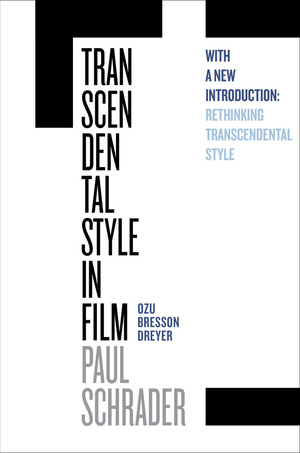
3. Transcendental Style in Film: Ozu, Bresson, Dreyer by Paul Schrader
Paul Schrader is a screenwriter and director, responsible for writing Martin Scorcese’s Taxi Driver, Raging Bull, and The Last Temptation of Christ amongst several other films, and directing several of his own, including the recent First Reformed. This book, written as part of his graduate work at UCLA, is an attempt to understand what he terms “transcendental style,” or the form that some filmmakers effectively use to connect their audience to something bigger than themselves, to the divine, in one reading of the films. Long out of print, the University of California Press recently released a new edition of the book with a new foreword that makes this kind of cult academic classic accessible once again, for which I am very thankful. Schrader’s analysis of his subjects is straightforward and accessible even for the depth of what it is trying to engage with. Chief among Schrader’s arguments is that transcendental style is a form of filmmaking, implying some semblance of an organizing logic that consistently pushes viewers in a particular direction that opens them up to consideration of the Holy or transcendental. That certain filmmakers are successful at affecting this style or form consistently speaks to their larger thematic concerns, and that others struggle to bring this style together consistently also illuminates their idiosyncrasies and beliefs. Tying the styles of Ozu and Bresson in particular to their spiritual backgrounds is useful in showing that this style and form transcends denominational or even religious lines, but then also begs the question of just what transcendent form these films are then paying homage to. Schrader often answers some theological questions or charges in his analyses, but sometimes seems to open up other questions that he either does not perceive or does not feel the need to address. Overall I found his argument compelling and interesting–but I would like to think about it more in other contexts, or in relation to other filmmakers who perhaps stretch the boundaries of his three-pronged definition of the form of transcendental style. I chose to highlight this book because it was profoundly moving and thought-provoking for me as I read it and experienced several intriguing, engaging films this past month, but I am still something of a skeptic, and hope to test or stretch its limits in my own academic and creative work going forward.
 Zachary Sheldon